5s
+1
Submission successful!

October 29, 2026

When an excavator's travel assembly starts leaking oil, making unusual noises, losing power, or struggling to move, owners face an important decision: rebuild the existing unit or replace it with a new complete travel assembly?
At first glance, rebuilding often appears to be the cheaper option. However, the lowest initial repair cost does not always mean the lowest total cost. Parts availability, internal damage, labor, downtime, and expected service life all affect the final decision.
Rebuilding means repairing the existing travel assembly by replacing worn or damaged components while reusing parts that remain within acceptable service limits. Depending on the design and fault, the work may involve seals, bearings, gears, the hydraulic motor, or other internal components.
Advantages of rebuilding
Lower initial cost: If the damage is limited, replacing only the affected components can cost less than purchasing a complete assembly.
Less parts replacement: Serviceable components can be reused after proper inspection and measurement.
Suitable for localized faults: Minor leakage, certain bearing problems, or limited internal wear may be repairable without replacing the entire unit.
Potential disadvantages
Hidden damage: Gears, shafts, bearings, or hydraulic motor components may have wear that is not obvious before disassembly.
Repair quality varies: The result depends on diagnostic accuracy, component quality, machining standards where applicable, and technician experience.
Possible repeat downtime: If worn components are missed or the root cause is not corrected, the assembly may require further repairs.
Rebuilding is often worth considering when the damage is clearly identified, the main components remain serviceable, and a qualified workshop can provide a reliable repair with appropriate testing.
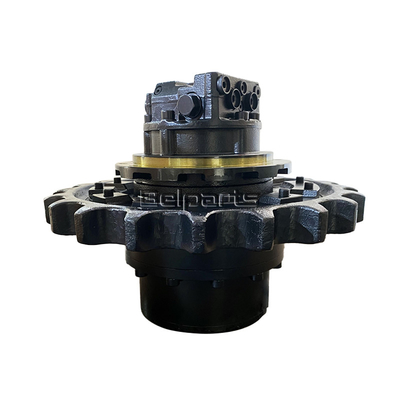
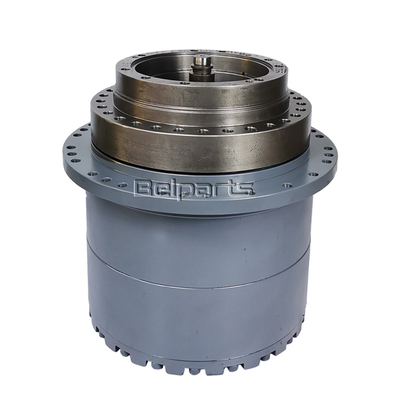
A complete replacement generally means installing a new travel assembly compatible with the excavator. Depending on the supplier and product configuration, the assembly may include the travel motor, final drive gearbox, or both.
Advantages of a new complete assembly
A more comprehensive replacement: The supplied components are replaced together rather than relying on a mixture of old and new internal parts.
More predictable repair planning: A correctly specified replacement can reduce the need to diagnose and repair multiple worn components individually.
Potentially shorter repair time: If the correct assembly is available, replacing the unit may be faster than dismantling, inspecting, sourcing individual parts, and rebuilding the original.
Supplier support and warranty: A reputable supplier may provide product testing, technical assistance, and warranty terms, depending on the agreement.
Potential disadvantages
Higher initial purchase price: A complete assembly can cost substantially more than repairing a limited fault.
Compatibility must be confirmed: Similar-looking units may differ in mounting dimensions, hydraulic connections, reduction ratio, or other specifications.
Quality still matters: A new unit is not automatically the best choice if its specifications, manufacturing quality, or supplier support are uncertain.
Replacement is often the more practical option when the gearbox has extensive internal damage, several major components are worn, repair costs are approaching replacement costs, or reliable rebuilding is not available locally.
The best comparison includes more than the parts price. Consider the following cost factors before making a decision.
| Cost factor | Rebuild existing unit | New complete assembly |
|---|---|---|
| Initial parts cost | Often lower for limited damage | Usually higher |
| Labor cost | Can increase with extensive dismantling and rebuilding | May be lower if installation is straightforward |
| Repair time | Depends on inspection and parts availability | Can be shorter if the correct unit is in stock |
| Risk of repeat repairs | Depends on the condition of reused parts and repair quality | Depends on product quality, compatibility, and installation |
| Warranty | Depends on the workshop and repair agreement | Depends on the supplier and warranty terms |
| Long-term value | Good when damage is limited and rebuilding is reliable | Attractive when major components are extensively worn |
A simple way to compare the options is to calculate the total expected cost:
Rebuild cost = parts + labor + downtime cost + expected future repair cost.
Replacement cost = complete assembly + installation + downtime cost + expected future repair cost.
For example, suppose rebuilding costs $1,200 in parts and labor, while a new complete assembly costs $2,000 and installation costs $200. If the rebuild also requires an additional $500 in downtime and expected follow-up costs, its estimated total becomes $1,700, compared with $2,200 for replacement.
In this example, rebuilding still costs less. But if the rebuild requires another repair or causes longer downtime, the difference may narrow or disappear. These figures are illustrative only; actual costs depend on the machine, local labor rates, parts prices, and operating conditions.
Before authorizing a rebuild or ordering a replacement, ask your technician or supplier to confirm four things.
First, identify the actual fault. Oil leakage, weak travel, abnormal noise, and overheating can have different causes. Check the hydraulic motor, final drive gearbox, seals, bearings, gears, and relevant hydraulic supply conditions as appropriate.
Second, assess the internal damage. After disassembly, inspect the affected components and determine which parts can safely be reused. If gears, shafts, or other critical components have severe damage, a limited repair may not be economical.
Third, compare the complete repair costs. Include labor, replacement parts, freight, installation, expected downtime, and any applicable warranty. Do not compare the price of a few replacement parts with the price of a complete assembly and assume that the difference represents the final savings.
Fourth, confirm compatibility before ordering. Verify the excavator model, serial number where applicable, original part number, mounting dimensions, hydraulic connections, and other relevant specifications. If the travel motor and final drive gearbox are supplied separately, confirm that their configurations are compatible.
Rebuilding and replacing a travel assembly can both be cost-effective choices. Rebuilding is often more economical when damage is limited and the remaining components are serviceable. A new complete assembly may offer better overall value when major components are badly worn, repair costs are high, or minimizing downtime is a priority.
For excavator owners, repair workshops, and parts distributors, the goal is not simply to choose the cheapest option. It is to find the solution that balances repair cost, reliability, downtime, and expected service life.
If replacement is the better choice, work with a supplier who can confirm the correct travel assembly configuration, provide clear product specifications, and explain the applicable warranty and shipping arrangements. Making the right decision before ordering can help avoid unnecessary costs and repeated downtime.